|
▸ THE TLDR
| → The Bitcoin bid got reframed — a Bitcoin Treasuries panel argued BTC isn't rising on the debasement trade — it's rising on the liquidity that AI-driven tokenization will unlock across ~$900T of assets. The IMF, Citrini, Bitwise, and the Nasdaq CEO all landed on the same scale this week. | | → BlackRock published the agent money stack — in "The Machine-Native Economy" (Sept 22), the world's largest asset manager laid out stablecoins as spend money, bitcoin as savings, compute as the new commodity. In the cited simulations, AI models picked bitcoin as store of value 79.1% of the time. | | → The agent-payment race went multi-player — Coinbase, MoonPay, MetaMask/Aave, and Sui/Alibaba all raced to give agents wallets, cards, or payment rails. But the honest audit: 6.4M agent-to-agent payments via x402 on Base/Solana moved just $120K in 35 days. Machine-scale counts, microscopic dollars. | | → World is shipping proof-of-humanity for agents — after a deepfake passed as human 48% of the time, World’s ZK World ID (proves you’re human without revealing who you are) is answering the question every site will ask: is there a real person behind this agent? Amazon already blocked Meta's shopping agent. | | → The week's big debate: can AI break crypto's math? — Justin Drake warned AI could crack ECDSA in months — "bunker mode" for big holders. a16z's cryptographers pushed back: no evidence any assumption weakened, and AI may become the math's hardest auditor. | | → Jordi Visser's value-capture frame — don't bet on AI models — they're commoditized. Bet on the toll collectors: crypto rails and compute. | | → Under the radar: an open-source AI pentest tool (ARTEX) was used to breach at least nine South Korean banks — 68,000+ customers affected. Nobody broke the math; they walked through the loan-status page. |
|
|
▸ SIGNALS Seven signals. Big idea first, receipts after.
01× The $900T reframe: Bitcoin's new job description
WHAT IT MEANS FOR YOU The reason to own bitcoin may be shifting under your feet — from ‘governments print money’ to ‘AI is moving the world’s assets onto crypto rails, and bitcoin sits at the bottom of those rails.’ If that thesis is right, bitcoin’s upside stops depending on inflation headlines. $900 trillion — that’s the number now attached to bitcoin’s new job description. At the Bitcoin Treasuries Conference (Oct 9), the case was made that bitcoin isn’t rising on the debasement trade, but on the liquidity AI-driven tokenization unlocks. Within days, the scale marks converged from independent institutional voices: the IMF’s October Global Financial Stability Report (Ch. 3) put tokenized real-world assets at just $65B against $300T of global capital markets; Citrini Research framed the equities opportunity at $157T; Bitwise's Matt Hougan put it at $150T in stocks plus $350T in bonds; Nasdaq CEO Adena Friedman said tokenizing Treasurys and equities could free "tens of billions" in trapped collateral — and that AI will play a growing role in real-time risk management for always-on markets. The compulsion thesis: tokenization flips from "want to" to "have to" — once agents do the buying, anything not machine-readable and onchain is invisible to them.
Why it matters: no single source told this story. A treasuries panel supplied the reframe, Hougan and the IMF supplied the numbers, the CFTC supplied the policy leg ("agentic finance"), and the builders supplied the rails. For the ledger: this is the competing thesis to "debasement," now with a multi-source number family.
CAVEAT — $900T is a ceiling, not a forecast — most assets won't tokenize for years, and a fraction migrating is still enormous. Debasement vs. tokenization isn't either/or; the panel framed it as a fight, but both can be true at once. Panel claims are user-reported paraphrase, not verified transcript.
02× BlackRock publishes the machine money stack
WHAT IT MEANS FOR YOU The world’s biggest money manager just published a playbook where your AI assistant spends stablecoins, saves in bitcoin, and rents computing power like oil. Wall Street isn’t debating whether agents need crypto anymore — it’s designing the plumbing. "The Machine-Native Economy: How digital assets connect intelligence, commerce, and compute" — published Sept 22 by Will Su (head of digital assets research), Robert Mitchnick (head of digital assets), Jay Jacobs (U.S. head of equity ETFs), and William Helm. The paper lays out the AI-agent money stack: stablecoins = spend money, bitcoin = savings, compute = the new commodity. In the cited Bitcoin Policy Institute simulations (36 frontier models, 9,072 monetary scenarios), simulated AI models picked bitcoin as long-term store of value 79.1% of the time and stablecoins for payments 53.2% — with over 90% of answers favoring digitally-native money over fiat. In the firm's blog this week, Mitchnick added the quotable thesis sentence: rising agent capability may drive demand for "payment and asset infrastructure designed natively for machine-speed commerce."
Why it matters: the institutional leg of the agent-economy thesis — it's not just Bitcoiners saying it anymore, it's the world's largest asset manager publishing it. Jason Lowery gave the thesis (Oct 6), BlackRock gave it institutional validation, Hougan gave it the advisor memo — a three-step arc in one week.
CAVEAT — BlackRock itself calls the simulation evidence "preliminary" — simulated model responses, not observed agent behavior.
03× The rail race is on — and the dollars are still tiny
WHAT IT MEANS FOR YOU Everyone is racing to give AI agents a wallet, but almost no real money is moving yet — 6.4 million payments, $120K total. The starting gun fired; the race hasn’t. Every payments incumbent raced to give agents wallets this week. Coinbase's Yuga Cohler said the exchange plans to be "the primary financial account for agents"; Coinbase Ventures backed Catalyst ("the future of finance and trading is agentic" — natural language into financial execution); MoonPay's chief engineer walked through Paybox, a non-custodial agent wallet inside the chat app (~500K signups at launch), plus the MoonAgents debit card for spending stablecoins at any Mastercard merchant; MetaMask's agent wallet integrated with Aave's MCP — agents plugged into DeFi borrowing, not just payments; Sui pitched per-task stablecoin billing to Alibaba Cloud. Keyrock's TOKEN2049 report put numbers on the last year: $73M across 176M agent transactions. But BeInCrypto's honest audit of 35 days of x402 payments (the open protocol for AI agents paying each other) on Base and Solana found 6.4M transactions worth just $119,947 total — 90.8% under one cent — with Solana's share concentrated in eight days, suggesting much of the volume isn't commercial demand yet.
Why it matters: the machine economy is scaling in transactions before it scales in money. The rails are real; the dollar throughput is microscopic. Track the ratio, not the press releases — that's the ledger's job.
CAVEAT — announced intent ≠ shipping (Sui/Alibaba is still under construction); Keyrock sells this ecosystem; x402 counts include non-agentic payments.
04× World: "is there a real person behind the agent?"
WHAT IT MEANS FOR YOU Soon every website may ask ‘are you a real person or an AI?’ before letting you in — and your answer might be a crypto ID in your pocket. The deepfake era is forcing the internet to check IDs at the door. “Is there a real person behind this agent?” Every site is about to start asking. World’s answer, in an Oct 2 blog post: zero-knowledge World ID, which proves you’re human without revealing who you are. Named integrations: Okta's Human Principal beta, Vercel's WorkflowSDK, Exa's free API credits, Browserbase navigation. The friction is already real: Amazon blocked Meta's Muse from shopping as if human without identifying itself as an agent. And after AI video company Tavus showed its Griffin-Lite model fooled 48% of participants into believing they'd spoken with a real person on a live video call (up from 2.4% a generation earlier), World replied on X: "This was inevitable. That's why @world_id for @Zoom exists."
Why it matters: the trust layer of the agent economy shipping in real time — a market collision (agents blocked at the checkout) with a crypto-native answer (ZK proof-of-humanity — cryptographic proof you’re human, without revealing who you are). It completes this week's triad: agents get wallets (signal 3), agents prove personhood (signal 4), agents settle markets (signal 1).
CAVEAT — company claims; adoption beyond the named integrations is unverified. Orb/biometric privacy concerns remain.
05× Decentralized AI graduates: Nous at $1.5B, Akash auctions every prompt
WHAT IT MEANS FOR YOU AI’s computing power is starting to trade on open markets — priced by auction, paid in crypto. A new commodity market is forming in real time, and ‘decentralized’ is being sold as safety, not ideology. Nous Research raised a $90M Series B at a $1.5B valuation — led by Robot Ventures, with Nvidia, Samsung, Union Square Ventures, Microsoft M12, and 1789 Capital — and launched "Hermes for Businesses," enterprise deployment of its open-source agent. Its Psyche network coordinates GPUs scattered across the internet to train models, settling the coordination layer on Solana. The same week, AkashML became the launch GPU partner for Architect's Liquid Inference: every inference prompt is auctioned and providers compete on price, routed to the lowest offer. In Bittensor, 24–25 subnets now reportedly generate real commercial revenue ($28–35M annualized), with "Gamma tokens" planned so subnets can pay each other for compute — inter-subnet commerce. And Ben Goertzel published a "Beneficial AGI in 20 Steps" roadmap framing decentralized infrastructure explicitly as the safety mechanism.
Why it matters: decentralized AI isn't a forum post anymore — it's a $1.5B company with NVIDIA money and corporate customers, live price discovery for inference, and paying customers in Bittensor. Decentralization is being framed as safety, not just ideology — which rhymes with this week's cryptography debate.
CAVEAT — usage/revenue figures are company-reported; Bittensor revenue claims are unaudited with inconsistent definitions.
06× NEAR: the "blockchain for AI" goes to market
WHAT IT MEANS FOR YOU Wall Street is starting to package ‘the AI-agent economy’ as an investment product. When a thesis gets an ETF, it’s left the chat rooms and entered the mainstream money conversation. Bitwise CIO Matt Hougan's Oct 7 memo called NEAR "the blockchain for AI" — infrastructure for AI agents transacting, founded by a co-author of the 2017 transformer paper. NEAR's Intents (cross-chain solver network) passed $30B cumulative volume. The same day, NEAR announced Robinhood Chain is live via Intents — swaps across 180+ assets, 30+ chains — and NEAR's own bio now reads "the unified commerce layer for assets and agents." Also that week, Bitwise launched NRR, the first US spot NEAR ETF — reportedly a top-10 September US launch by AUM. And on Melker's show (Oct 9), Hougan said agentic commerce's money side is "going to be here in months," while calling AI-directed actively managed crypto ETFs an eventual (~18 months out) evolution, not an announcement.
Why it matters: thesis → product → ETF within days. NEAR is the clearest single asset where the "agents need crypto rails" thesis is being packaged for advisors — and Hougan is the institutional translator. Pairs with Jordi Visser's 2023 callback: NEAR's Polosukhin was calling agents the economic actors of the future years ago.
CAVEAT — one institution's memo on one token — a data point in the theme, not a call. The ETF banter was speculative, not a Bitwise product announcement.
07AI/crypto Masad's corollary: when AI can read everything, only math-secured trust survives
WHAT IT MEANS FOR YOU The internet’s next trust system won’t be ‘trust us, we’re a big company’ — it’ll be cryptographic proof. The ‘don’t trust, verify’ idea behind bitcoin is becoming the infrastructure AI agents run on. Replit CEO Amjad Masad: AI-powered reverse engineering and decompilation is getting so good that "pretty soon all software will be de facto open-source." Security-through-obscurity dies; what survives is secured by math. The crypto-side confirmation arrived the same week: Ethereum researcher Justin Drake is urging large holders into "bunker mode" — fresh addresses whose public keys stay hashed — preparing for a world where AI accelerates math itself.
Why it matters: the philosophical spine of the whole edition: "don't trust, verify" is becoming the infrastructure of the agent economy. Pairs directly with The Debate below.
CAVEAT — pure-AI signal plus an interpretive bridge; the Drake item is expanded in The Debate.
SKIPPED WITH INTENT — the "BULLISH ETH and SOL" engagement-bait framing of the AWS/x402 story — the x402 payments angle is covered above without the hype. We'll always tell you what we skipped.
|
|
▸ THE DEBATE — CAN AI BREAK CRYPTO'S MATH BEFORE QUANTUM DOES?
WHAT IT MEANS FOR YOU Your crypto is almost certainly safe today — but the people who build the locks are now racing AI that learns to pick them. The good news: the same AI makes the locks stronger. We’ll keep score in the ledger.
|
TAKE 1 — BRACE (DRAKE + VITALIK)
Drake (Ethereum Foundation researcher; Bankless episode, ~4M views): it's now reasonable to brace for ECDSA — the signature math securing Bitcoin — breaking before "qday" (the day quantum computers break encryption) — worst case, months not years — with private keys recoverable in ~a week on a large GPU cluster. His call: a calm, mass migration to "bunker mode" — fresh addresses whose keys stay hidden behind a hash, starting with large holders. Vitalik: don't scramble to move funds today, but "take the risks to cryptography from AI-accelerated math seriously" — even lattice-based schemes treated as quantum-safe could weaken within ~2 years.
|
|
TAKE 2 — THE CRYPTOGRAPHERS (a16z)
Justin Thaler: "We generally believe there is no efficient algorithm for these problems... if there is not one, it doesn't matter how smart the AI is." Eddy Lazzarin: "We didn't learn that any specific cryptographic assumptions have less security than they did before." Dan Boneh: the same AI that scares people about cryptography will also help get all the bugs out — "we can just let a model run for a month, try to break it, and if the model can't break it, boy, do we have a lot of confidence that the assumption is valid."
|
Our read: both sides agree AI accelerates math — the fight is whether it accelerates attacks or defense. Boneh's honest hedge is worth more than either extreme: if the AI threat materializes, it may skip elliptic curves and hit the post-quantum replacements. The actionable takeaway (Marty Bent's): don't panic, don't reuse addresses — hygiene reduces exposure regardless of the timeline. If the models keep cracking math conjectures but produce no cryptographic result, the math holds; if a result appears, "bunker mode" goes from plan to drill. We'll track it in the ledger.
|
|
▸ UNDER THE RADAR
An open-source AI pentest tool breached at least nine South Korean banks.
WHAT IT MEANS FOR YOU AI made hacking so easy that amateurs can now rob banks — and what’s being stolen is customer databases: names, phone numbers, incomes. The weakest link was never the math; it’s the honeypots of personal data.
ARTEX (running DeepSeek plus Claude Code sessions) exfiltrated loan-application data of ~25,000 Shinhan Bank customers; 68,000+ people affected. The attacker left open directories full of Claude Code session histories — even asking Claude where to sell the breach data. South Korea's president: AI has made hacking easy "even for those without special skills." Nobody broke the math; they walked through the loan-status page. (via TFTC's The Commoner, Oct 9)
The DOE told PJM: data centers pay their own way.
WHAT IT MEANS FOR YOU AI data centers use so much electricity that your power bill is now part of the AI story — regulators are deciding who pays for it: you, or the data centers.
A FERC filing (Oct 7) urges cost-allocation reform so data-center power costs "are not unfairly shifted" to existing ratepayers; PJM plans a revised proposal by Oct 29. Five U.S. counties passed moratoriums the same week; Finland halted Google's €13B data centers. Power policy is now compute policy.
|
|
▸ MARKET PULSE · as of Oct 13
BTC $83.3K +1.2% day | ETH $2,499 +0.9% day | STABLECOINS ~$307B DeFiLlama, Oct 6 | FEAR & GREED 57 Neutral | ETF FLOWS −$681M last week, most since Jun |
BTC held $81K support and rebounded to ~$83.3K; ETH ~$2,499. WTI ~$92 (−1.5%) as the Saudi-attack premium faded. U.S. CPI lands tomorrow, Oct 14. (CoinDesk, SoSoValue.)
|
|
▸ CHART OF THE WEEK
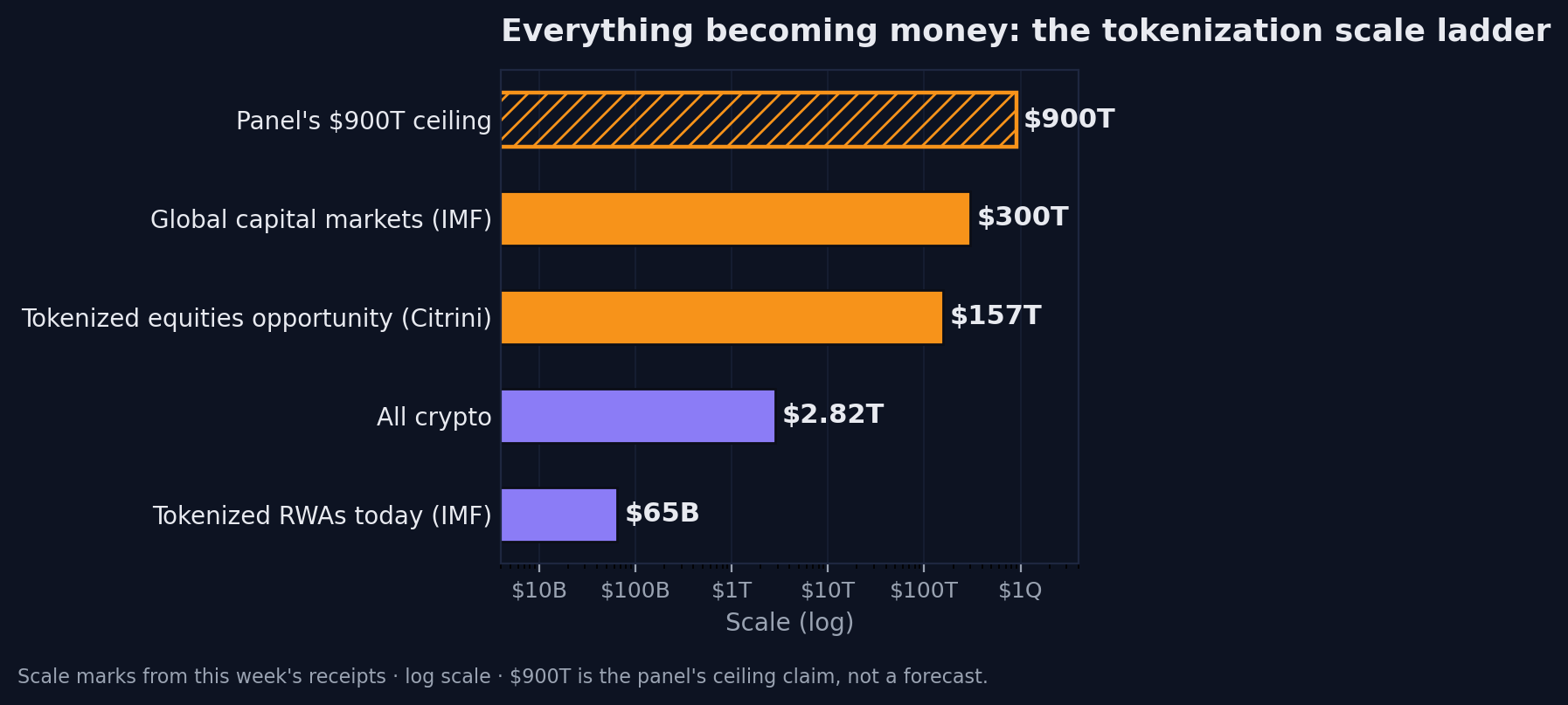
The tokenization scale ladder: how much of the world's assets are onchain today vs. the scale marks landing this week — IMF ($65B vs $300T), Citrini ($157T equities), all crypto ($2.82T), the panel's $900T ceiling. Scale marks from this week's receipts, log scale. The $900T bar is the panel's ceiling claim — most assets won't tokenize for years.
|
|
▸ MISSED & MISTAKEN · launches edition #2
What did we miss? Where were we wrong?
Reader corrections and additions, credited — launching once there's an audience to reply.
Corrections get logged in the ledger. New sources join the rotation.
|
|
▸ THE TRUST LEDGER · the scorecard
WHAT THIS IS — our running, timestamped record of the biggest calls from the voices we track — quoted verbatim, scored honestly over time. Wrong calls stay visible. That's the point.
Status: early too soon to tell · holding playing out · evolving partially right · dead wrong, still visible · Trend → which way the call is moving
NEW ON THE RECORD
Calls made this week, timestamped today. We start scoring them next week.
#4 · NEW · Oct 5–9 · Status: early
"payment and asset infrastructure designed natively for machine-speed commerce"
— Robert Mitchnick (BlackRock, head of digital assets)
Tracking: agent-settlement volume data (x402 series, Keyrock's annual report) will confirm or embarrass this.
#5 · NEW · Oct 7 · Status: early
"Coinbase is securely making its capabilities available to AI agents. We plan on being the primary financial account for agents. More soon - watch this space."
— Yuga Cohler (Coinbase)
Tracking: product-launch follow-through — does the "primary financial account" ship, or stay a post?
#6 · NEW · Oct 10 · Status: early
"Now we can just let a model run for a month, try to break it, and if the model can't break it, boy, do we have a lot of confidence that the assumption is valid."
— Dan Boneh (Stanford; a16z crypto)
Tracking: any AI-accelerated cryptanalysis result — published attack or not. Watch the post-quantum replacements too, per Boneh's own hedge.
CHECK-INS — ENTRIES #1–3
HOW THIS WORKS — earlier calls, re-scored against what actually happened since. Anyone can make a call — we stick around to grade it. That's the compounding asset: give it a year and this box is a public track record nobody else has. First logged Oct 6 (pre-launch; first public scoring).
#1 — Visser: crypto's "Micron moment" · Status: early · Trend: ↗ toward holding
The original call: "Crypto is at its 'Micron moment': AI agents + tokenization + stablecoin payments will send token volumes 'through the roof,' repricing the market faster than investors expect."
This week: the thesis keeps gathering witnesses. Jordi himself added the "toll collectors" frame on Pomp (Oct 10): bet on crypto rails and compute, not models. Keyrock's $73M/176M-txn report plus the honest BeInCrypto audit (tiny dollars, machine-scale counts) give it numbers with caveats. The CFTC's Sept 23 "agentic finance" statement recirculated this week — the policy leg arrived before the builders. First substantive scoring still needs a sustained agent-volume series and one actual rule.
#2 — Amodei's "pace the frontier" becomes industry policy · Status: early · Trend: → steady
The original call: "Amodei's 'pace the frontier' is becoming industry policy: Altman, Musk, and Hassabis cosigned it, and the White House accord adopted its vocabulary of external evaluators and layered audits."
This week: no new endorsements or enforcement events this week. Watch unchanged: whether any evaluator ever gets real, unredacted access.
#3 — Hayes: the AI "safety slowdown" is a credit story · Status: early · Trend: → steady
The original call: "The AI 'safety slowdown' is a credit story: $1T+ of AI infrastructure debt can't be serviced if labs slow compute buying; Washington will either become a 'compute buyer of last resort' or print — either way, dollar liquidity expands, which is bullish for Bitcoin."
This week: macro backdrop: 30-year Treasury at 5.711% (highest since 2002), $681M in weekly spot-BTC ETF outflows (most since June). The stress test continues: AI capex pace and data-center credit conditions into 2027.
Market snapshot at this check-in (Oct 12): BTC ~$83.7K · ETH ~$2,555 · stablecoin supply ~$307B (DeFiLlama, Oct 6) · Fear & Greed 69.
|
|
Know one person who'd get this? Forward it to them.
Receipts grows one forward at a time.
|
|
Receipts · The week in crypto×AI, documented.
Nothing here is investment advice.
Unsubscribe · View in browser · Forward to a friend
|
|