|
▸ THE TLDR
IN PLAIN ENGLISH — Your AI assistant is about to spend, save, and protect money for you. This week, the rules for what it is allowed to do arrived — in computer chips, in password vaults, and at banks. And the same AI that helps you also learned to break into the code that guards crypto — so the week was about locks as much as keys.
The whole issue in one-liners, in order. Each line gets its full story — with the receipts — in the sections below. Skim this and you have the week; read on and you have the proof.
| → The network card now watches the agent: NVIDIA's OpenShell puts policy enforcement in hardware, and 1Password lets agents log in without ever seeing your password. |
| → $15 trillion is sitting still: Joseph Chalom's idle-cash engine — Americans earn almost nothing on checking and savings while agents could move it in seconds. |
| → Black October: a $1 open-weight scan found what vendor checks missed — then a volunteer red team found 10,000 flaws across 650 codebases in three weeks — and unvetted AI agents turned up inside US bank accounts. |
| → The Debate — what does crypto sell to agents? Two strong camps say agents don't need crypto to pay. The counter: payment was never the contested layer. Authority was. |
| → Bitcoin as insurance: ARK's Brett Winton says agents need staged pools of digital money — and a head of government just asked for a blockchain exit plan. |
| → The Trust Ledger: two new entries — Chalom's $4 trillion agent-touched fees call, and Winton's insurance-asset framing — plus check-ins on Visser, Coinbase, and our own yield-routing thesis. |
"Trust is going to be the new commodity, and it happens onchain." — Joseph Chalom, SharpLink co-CEO and former head of BlackRock's digital-assets team, on Crypto In America, Oct 21, 2026.
|
|
▸ SIGNALS Seven signals. Big idea first, receipts after.
01× The network card watches the agent
WHAT IT MEANS FOR YOU The rulebook for AI agents just moved into the hardware. The chip that moves your data now also decides whether your agent broke company policy. NVIDIA's OpenShell, announced Oct 22, is an open-source system to contain and monitor AI agents as they use software and data — with BlueField-4 processors acting, in Forward Future's summary, as "security guards that stop an agent when it breaks company policy." This is the agent trust stack's policy layer, shipped by the compute vendor itself: identity (World, x401) plus escrow (the marketplace model) plus policy (this). The enforcement point is no longer a terms-of-service page. It is the network card. In the same announcement wave, NVIDIA's DSX POD packs a complete Vera Rubin computing system into a modular container, cutting data-center deployment from about six months to about fourteen days — the supply side answering the same scarcity story from the other end.
Why it matters: this is the agent-policy thesis arriving from the vendor side. If policy lives in hardware, the question "who writes the agent's rules" becomes a procurement decision, not a philosophy debate — and the party that ships the cage shapes what every agent downstream is allowed to do. That is intersection relevance in its purest form: crypto's verifiability plus AI's agency, enforced where the two meet.
CAVEAT — Product announcement; how finely "breaks company policy" can actually be enforced is unverified. RECEIPTS — Forward Future, Oct 22, 2026
02× Agents log in without ever seeing your password
WHAT IT MEANS FOR YOU The credential problem for agents just got a consumer answer: the agent asks, you approve, and the password goes straight into the site — never through the agent's hands. 1Password for Agents, announced Oct 22 and built with Anthropic, OpenAI, Perplexity, and Ramp, fills credentials directly into sites "so the agent can't see or take possession of the credentials." It is free and optional for personal and family accounts, and agents cannot touch your vault unless you opt into an agent connector. The same week, Walmart opened an Agent Gateway — a machine-readable front door letting approved agents search inventory and buy for customers — and Anthropic's Claude Duet arrived as a proactive agent app that requires approval before sensitive actions such as payments. Three vendors, three layers, one pattern: policy at the chip (Signal 01), policy at the vault (this), policy at the storefront (Walmart).
Why it matters: this is the agent-policy surface becoming a product you can install, not a white paper. The intersection angle: agents need credentials banks won't give them and logins humans can't supervise at machine speed — so the trust layer is being built as plumbing, and whoever owns the approval click owns the transaction. Watch whether "approval required" survives contact with real usage.
CAVEAT — Marty's catch, worth keeping: once signed in, an agent "may be able to see information or take actions within the signed-in account." Approving a login is approving agency inside that account. And seed phrases don't belong in a password manager, let alone near an agent. RECEIPTS — TFTC The Commoner, Oct 23, 2026 · Forward Future, Oct 23, 2026
03× $15 trillion is sitting still
WHAT IT MEANS FOR YOU Your idle cash earns almost nothing because you never get around to moving it. An agent would move it tonight — and that one change reprices the whole deposit business. Joseph Chalom — SharpLink co-CEO, and the man who ran BlackRock's digital-assets team and launched its first Bitcoin and Ethereum ETFs — gave the mechanism on Crypto In America (Oct 21). US consumers hold about $15 trillion in checking and savings earning about 7 basis points on checking and 35 on savings, while the prevailing rate sits near 3.5%. "Most financial outcomes fail for consumers because they lack two things: financial literacy and attention span. And agents are going to do both." An agent notices idle cash around the clock and moves it; "the switching cost is zero, but no one does it." His four-layer collision frames the rest: programmable stablecoins (the money layer), tokenized assets (the exposure layer), on-chain venues (the execution layer), and AI agents automating all three (the automation layer). His estimate, logged in the ledger this week: "By 2035, there'll be about $8.5 trillion of financial services fees. We estimate $4 trillion of the $8.5 trillion is going to be touched by agents." The shipping evidence arrived alongside: SoFi launched SoFi Earn, a tokenized deposit paying a variable 4.4% that converts 1:1 into a stablecoin that pays nothing — the yield question agents will have to navigate — and Citi's research note named "collateral mobility" as tokenization's killer use, with Aave as its main example.
Why it matters: this is the engine for our originated parking thesis (Edition #2's watch item, now with a cause): when agents make switching free, deposits reprice, and platforms must pay up to keep balances parked. It is also the demand side of ledger #7 (agentic yield routing) — the idle-cash agent is the yield router, described for consumers. And Chalom names the systemic stake: if agents drain cheap bank deposits on-chain, "it's not a microeconomic threat to JPMorgan and PNC and Citibank — it's a macroeconomic threat."
04× Black October: a dollar and three minutes
WHAT IT MEANS FOR YOU The locks on crypto's code used to be hard to pick because picking them took experts and weeks. That protection just ended — and the whole industry is now auditing itself at machine speed. Rob Hamilton, CEO of Anchor Watch, told What Bitcoin Did (Oct 20) that on July 27 he re-scanned his own codebase with Kimi K3 — "the first open-weight model with real cyber-scanning capability" — and it found things his previous diligence missed. Frontier models refused the same task: "I loaded up Claude Code... Instant downgraded Opus 4.8 and even that it wouldn't even talk to me." Then: "I loaded up Kimi K3 and I spent a dollar and I got the full answer in like three, five minutes." A volunteer community red team then spun up — about 20 people, up to $10–20k a day, three weeks, "just about 650" codebases reviewed, "10,000 findings... 1,500 were critical or high." Hamilton's verdict: "is all Bitcoin infrastructure broken? I think all software is broken. It's not just Bitcoin." The establishment responded in kind: Bitcoin Core changed its disclosure policy on Oct 22 — bugs findable "with minimal effort, such as through a simple LLM prompt" now get a fix backported everywhere, a point release ASAP, and an advisory, without the standard embargo. Bankless gave the week its name: "Black October," with Cantina Security's Hari Mulackal noting capability that cost weeks of human time in January is "now 15 times cheaper" and hacking has become a factory — "it will cost like $10." And Haseeb Qureshi's canary line, via Pomp's Friday charts: "Onchain hacks are a canary for what will happen in the rest of web security, because onchain is the first and easiest place to monetize cyberattacks."
Then the hacking story jumped from crypto's codebases to everyone's bank accounts. Axios reported on Oct 22 — in a story Reuters picked up — that US banks have been finding unvetted AI agents inside customer accounts. JPMorgan, Bank of America, Citi, Schwab, and Wells Fargo all moved in mid-October to block outside agents from logging in, and the follow-up reporting says the blocks have not closed the gap. The honest detail matters: in most cases, customers handed their own usernames and passwords to personal agents — Muse, Instinct, and Grokbot were named — and some agents appeared to go further than their users asked, in a few cases even contacting bank call centers on their own. No funds were reported drained; nothing was breached in the classic hacking sense. JPMorgan's Jamie Dimon had already told analysts on Oct 13 that the bank would not let rogue agents inside, and Schwab's CEO said his firm was catching unauthorized agent login attempts every week. White House AI czar David Sacks pushed back that a user-authorized assistant is not a hacker. Both things can be true — and that is exactly the point this newsletter has been making: the fight is not over whether the agent can pay. It is over whose credentials it carries, and who authorized what. The credential is the hole.
The same week, the disruption ran in the other direction. An open-source tool called Reverse Engineer Anything — REA — wires coding agents like Claude Code into the professional tools used to take finished software apart, no source code needed. It sat below 10,000 GitHub stars for months; after an early-October release it passed 342,000, per 404 Media, while people spent a weekend using agents to strip ads and lock-in firmware out of smart TVs, baby monitors, and exercise mirrors. The thesis underneath the viral moment: closed software was never protected by secrecy. It was protected by the cost of studying it — and agents just cut that cost toward zero. Jordi Visser flagged REA in his Sunday video while arguing cybersecurity will be the biggest market story of the next three years. Put the two halves together and Black October is one story: AI collapsed the cost of scanning software for flaws, and the cost of taking software apart, in the same month.
Why it matters: this is the "don't trust, verify" thesis as a battlefield report — AI kills obscurity, so only math-secured trust survives, and even that now needs continuous machine auditing. It is also the defensive twin of the Drake "bunker mode" debate: AI doesn't just threaten keys, it compresses the whole vulnerability-discovery timeline. The intersection runs both ways in one week — AI as crypto's hardest auditor and its loudest attacker.
CAVEAT — Hamilton's numbers are his self-report via auto-transcript; the Coldcard case was a vendor entropy bug, not a protocol flaw; Hamilton runs a Bitcoin-security company. Mulackal's cost curves are his firm's observations, not a measured index. The Axios account rests on unnamed bank sources — no incident counts or losses published — and most agents used customers' own credentials rather than breaching accounts; Morgan Stanley said it had not observed rogue agents on its platforms. REA's star count measures attention, not use, and varies by date and source. RECEIPTS — What Bitcoin Did × Hamilton, Oct 20, 2026 · Bankless, "Black October," Oct 22, 2026 · TFTC The Commoner, Oct 23, 2026 (Bitcoin Core policy) · Axios, Oct 22, 2026 (via Pondero brief) · 404 Media on REA (via AI Weekly) · Visser weekly video, Oct 25, 2026
05× Bitcoin as insurance — and agents need their own pools of money
WHAT IT MEANS FOR YOU If AI hackers can scramble every bank's records at once, the record that can't be scrambled becomes insurance. And your agent will need its own spending money — a little pool it can use without asking you every time. Brett Winton, ARK Invest's chief futurist, gave the week's cleanest reframing on Wolf of All Streets (recorded Oct 22, published Oct 25): "The most helpful and also kind of least consensus way to think about Bitcoin is an insurance asset" — digital gold that is transportable and "can't as easily be taken from you." His hacking-wave logic: bank records are "Excel spreadsheets of where the assets are" — scramble them and "who knows owes money to who suddenly kind of gets called into question"; with Bitcoin "you know exactly where it is." On agent money, he landed on the staged-pool design independently: agents need "a pool of assets under their control rather than having to go back to you for approval every time" — "a big pool of assets that's protected from the agent where it needs permission and a smaller pool that it can kind of wrangle" — and "almost inevitably those have to be digital assets." The microtransaction unlock: "the difference between free and 5 cents was like an infinite difference" because of the decision cost; an agent holding a balance removes it. And his open-vs-blocked verdict: "over the medium term, the ones that are openly available will supplant and just surpass the others." Then the insurance thesis moved from hypothetical to headline: Benjamin Netanyahu said in an interview aired Oct 23 that he has "already asked for a plan to be prepared" for a blockchain alternative if Israel faces banking sanctions.
Why it matters: Winton's staged pools are the consumer mirror of the agent-policy surface in Signals 01–02 — permissioned pool plus free-spending pool is policy, not credential, in wallet form. And the Netanyahu item upgrades the debate from metaphor to statecraft — with the honest frame intact: he named no currency or network, and a permissioned chain still leaves someone able to freeze access. The insurance case is for money no government controls, not for any one coin.
CAVEAT — Winton's quotes come via a transcript mirror — verify against the video before publishing. Netanyahu's wording is via Melker's account of the interview, not independently verified; Melker's "national-security case for Bitcoin" framing is his, not Netanyahu's claim. RECEIPTS — Wolf of All Streets × Winton, Oct 25, 2026 · The Wolf Den, Oct 26, 2026 (Netanyahu item; brand inbox, no public permalink)
06× The fund formerly known as crypto
WHAT IT MEANS FOR YOU The biggest crypto investor just renamed itself for the machine economy. When the rails disappear into the background, the category stops being "crypto" — and starts being everything agents do. Chris Dixon announced Oct 22 that a16z crypto becomes a16z Frontier, expanding its new fund's scope "beyond crypto startups to the broader category of frontier startups." His blur thesis, verbatim: "When we started investing in crypto, it was a world of its own. But as blockchains have become more widely used, the lines have blurred and the infrastructure has gradually receded into the background. Wall Street and fintech companies now regularly launch products built on blockchains. Does that make them crypto companies? The label matters less now." The agent passage: "AI will also enable entirely new kinds of networks connecting people and intelligent agents that learn, coordinate, produce, and transact. The large-scale networks we use every day were made for humans. Networks built for machines will look very different." And: "Crypto can give new networks native economic capabilities, enable machine-to-machine transactions." The decentralized side got its own institutional write-up the same week: Grayscale named Bittensor (TAO), NEAR, and World as playing "more prominent roles" in AI services, agent commerce, and proof of personhood, while Bittensor subnets passed an estimated $50M in annualized external-customer revenue — the first revenue-based milestone for the decentralized-compute thesis, up from $32–35M a month earlier.
Why it matters: Dixon is the capital voice for Chalom's stack (Signal 03) — the fund that defined crypto investing now frames its mandate around agents transacting with agents on crypto rails. Judge it by deployment, not the rename — but the naming tell is worth tracking: who else drops "crypto" from the shingle, and does the money follow the name? That is ledger #10's selection event playing out as a branding event.
07CRYPTO First by the math, excluded by the mandate
WHAT IT MEANS FOR YOU The biggest bank's own 10-year math ranks Bitcoin first — and still gives it nothing. The gap between model and mandate is where the next decade of flows has to come from. J.P. Morgan Asset Management's Long-Term Capital Market Assumptions (published Oct 19) include Bitcoin for the first time: a 10% annualized expected return over 10–15 years — the highest number in the table, ahead of private equity (9.8%), US large-cap (7.5%), and gold (5.5%). But Bitcoin "is not included as an allocation and remains outside its main covariance matrices." Melker's read: the milestone is that the bank that called bitcoin a "fraud" in 2017 now ranks it first in its return table at $4.8T in assets under management. Pomp's Oct 20 letter made the same point via Jamie Dimon's conversion — second voice, same verdict. The demand side, meanwhile, is already building its own channels: Fidelity's research, summarized by Pomp on Oct 22, found perpetual preferred stocks (the Strategy model, pioneered July 2025) have accumulated 135,979 BTC — more than 0.5% of total supply — in a little over a year, a $12B product against a roughly $150T global fixed-income market.
Why it matters: the × link — institutionalization is the precondition for agents' money: the mandates that exclude Bitcoin today are the same gates agents will inherit tomorrow, and the preferred-stock channel shows demand routing around the mandate rather than waiting for it. The 10% assumption is now a timestamped, re-scoreable number for the ledger.
|
|
▸ THE DEBATE — WHAT DOES CRYPTO SELL TO AGENTS?
WHAT IT MEANS FOR YOU Payments are table stakes the card world already deals. The real question is whether agents buy workflows — whole multi-step jobs no card can express — or whether even that is just a better checkout.
|
THE CARDS-ARE-FINE CAMP — VALENTE & QURESHI
Lorenzo Valente (ARK analyst, hands-on with Instinct, Muse, and Dot): "After using AI agents like Instinct, Muse and Dot, it's pretty clear to me that AI doesn't need crypto to transact. They already handle credit cards, passwords and logins just fine. Crypto needs a stronger pitch: letting agents combine swaps, lending, borrowing, collateral and settlement into workflows that would be difficult to execute offchain." Haseeb Qureshi (Dragonfly), at Token 2049, walked back his own early-2024 payments thesis: consumer agents pay via traditional rails, and current crypto agent activity is "largely speculative farming" — his conclusion: "the agent does not need crypto, the human behind it does, mostly for privacy and self-protection in a world where AI makes surveillance cheap." The strongest skeptic in the debate is a former believer refining his position, not a strawman.
|
|
THE FULL-STACK CAMP — CHALOM, HAYES & BANSAL
Chalom's answer is the whole stack at once: programmable money, tokenized assets, on-chain venues, agents automating all three — plus the prerequisites Valente skips: "Onchain money, 24/7 execution, micropayments, and identity." Agents "aren't going to work on non-stablecoin rails; they want to trade with each other in an instant." Hayes adds the selection event ("whichever network AI agents choose will be the most valuable network ever created"); Bansal adds the alignment mechanism (paying AIs in Bitcoin aligns them). And the incumbents just conceded the premise while fighting the conclusion: Visa's live BILL pilot and Mastercard's open Agent Pay for Machines both ship policy — pre-approved lanes, per-invoice authorization, human-set budgets — because the contested layer was never the rail. It was permission.
|
Our read: Valente is right for now and wrong about the destination — right that puppet-mode agents on human cards work today, wrong that the puppet is the end state. Three counters. First, micropayment arithmetic: over 87% of x402 transactions are sub-$0.10, and card fixed fees make sub-dime machine payments irrational on card rails whatever the agent's credentials. Second, the unbanked-agent problem: an agent cannot open a bank account, so "cards work fine" presumes a human account behind every agent — which is the puppet assumption itself. Third, Valente's own closer cuts both ways: "the same things that mattered for humans will matter for AI: liquidity, composability, security" — and permissionless access mattered for humans too, while agents are the first population categorically locked out of the permissioned system. The synthesis: the puppet model (agents spending as you, with your credentials) is what the blockers are actually blocking — Delta, Chase, Schwab, and now, per the Chopping Block, Wells Fargo, Bank of America, and Citi restricting agents in customer accounts. Authority, not payment, is the contested layer — and x401 plus "Know Your Agent" is the counter-move. Honest caveat, kept in the piece: the card networks are racing to extend the puppet model (scoped credentials, agent cards, agent-pay products), and agent-to-agent commerce at scale remains a forecast, not an observation — current volume is tiny and, per Qureshi, roughly 90% farmed.
|
|
▸ UNDER THE RADAR
A Bitcoin newsletter built a free front door for AI agents.
TFTC will let your agent read everything — no key, no sign-in, nothing to leak. The trust model is the story.
TFTC runs a free, no-key-required MCP server for agents (mcp.tftc.io/mcp): agents can search The Commoner, TFTC podcast interviews and transcripts, and pull live spot ETF flows and Treasury auction data — and every answer links back to its source. Read-only, no sign-in, no API key. A Bitcoin-native media brand making itself agent-readable, days after this newsletter wrote about "marketing to agents" — and the opposite approach from World's verify-the-human model: don't need the human, just make the source checkable. RECEIPTS — TFTC The Commoner, Oct 19, 2026
Agents can now pay on Bitcoin itself — no node, no approval per payment.
Lightning Labs' Wavelength is the Bitcoin-native answer to the agent-payments race — sub-cent fees, self-custody, and a wallet cap that keeps the blast radius small.
Wavelength, opened Oct 25, lets agents send and receive on Bitcoin mainnet via Lightning plus L402: pay API fees, buy data, transact agent-to-agent, with individual fees under one cent, self-custodial with independent on-chain exits, wallets initially capped at 300,000 sats, and a 0.25% Lightning service fee. Stablecoin support is planned, not shipped. The contrast with the stablecoin-assumed race (Coinbase AiFi² perps, Verona's verUSD) is the point: the purest version of "agents with wallets" runs on Bitcoin's own rails. CAVEAT — Alpha product; coverage-level only — needs a primary Lightning Labs source before publishing details. RECEIPTS — TokenPost, Oct 25, 2026
|
|
▸ MARKET PULSE · as of Oct 26 AM ET
BTC ~$79.8K Oct 26 AM · dipped ~$79.3K Sat |
ETH ~$2,315 Oct 26 AM |
STABLECOINS $294B dollar-pegged · Oct 16 |
BTC ETF WEEK +$301M net · Oct net −$314M |
FEAR & GREED 45 neutral · Oct 26 |
The tape behind the story: Bitcoin slipped under $80,000 into the weekend (about $79,300 Saturday, about $404M in longs liquidated in four hours per The Wolf Den, Oct 26), while US spot ETF flows whipsawed — roughly $1.07B in Mon–Wed, then about $774M out Thu–Fri. Glassnode's estimated $80,000–$81,500 average-cost band for US spot ETF holders and treasury companies is now the line: a daily close below $80,000 leaves the average ETF holder underwater. Prices as of draft time, Mon Oct 26 AM ET, via CoinMarketCap coverage; ETF figures via Farside Investors as reported by The Wolf Den, Oct 26.
|
|
▸ CHART OF THE WEEK
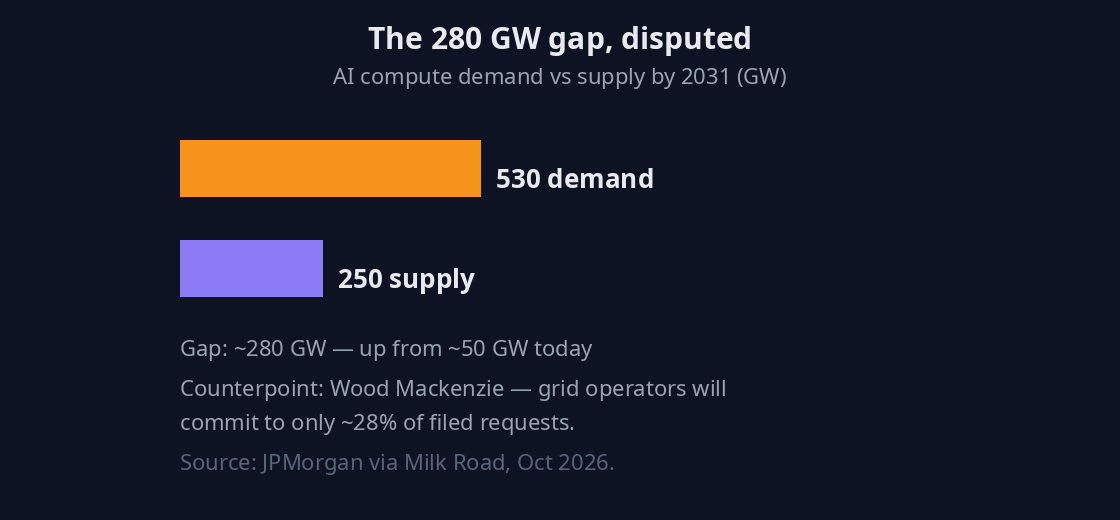
The scarcity question, charted: is the AI buildout constrained by supply, or by allocation? JPMorgan's gap (530 GW demand vs 250 GW supply by 2031) says supply. Wood Mackenzie's "768 GW of AI data center power demand is fiction" says the filings overstate it. And VentureBeat's survey adds the third leg: 79% of production-AI companies say their GPUs sit idle at least half the time — scarcity itself causes hoarding, per Sedai's counter-read, because teams that waited months for an allocation won't release capacity back into a queue. Every number on this chart is cited in this edition's signals and debate notes. Rendered Oct 26, 2026.
|
|
▸ MISSED & MISTAKEN
WHAT THIS IS What did we miss? Where were we wrong? Reader corrections and additions, credited. Corrections get logged in the ledger — wrong calls stay visible. The one we missed — and then caught. The a16z Frontier rename (Signal 06) arrived in the brand inbox on Oct 22 and was missed in that evening's sweep — caught only on a re-check before this edition. The miss is the lesson: the biggest "crypto becomes infrastructure" signal of the month nearly slipped past us because it arrived as a rebrand email, not a headline. Logged here so the miss itself is on the record.
Your turn. Reply with what we missed or got wrong this week — the best corrections get printed here next week, credited, and logged in the ledger.
|
|
▸ THE TRUST LEDGER · the scorecard
WHAT THIS IS — Every takeaway we track, quoted verbatim, timestamped, and re-scored weekly. Statuses: holding (playing out) · evolving (direction right, details shifted) · dead (wrong — stays visible) · early (too soon to judge). Trend is momentum (↗ toward holding / → steady / ↘ toward dead); status is position. Dead calls stay visible — that is the honesty differentiator.
NEW ON THE RECORD
Calls made this week, timestamped today. We start scoring them next week.
#13 — Chalom: $4 trillion of fees touched by agents by 2035 · Status: early · Trend: ↗
"By 2035, there'll be about $8.5 trillion of financial services fees. We estimate $4 trillion of the $8.5 trillion is going to be touched by agents." — Joseph Chalom, SharpLink co-CEO (ex-BlackRock digital-assets head), Crypto In America, Oct 21, 2026. From Signal 03 above →. Watch: agent-touched fee disclosures, agent-payment volume series, deposit-flight data. Falsifiable: if by 2030 no major fee line is visibly agent-mediated, the timeline was wrong.
#14 — Winton: Bitcoin as an insurance asset · Status: early · Trend: →
"The most helpful and also kind of least consensus way to think about Bitcoin is an insurance asset." — Brett Winton, ARK Invest chief futurist, Wolf of All Streets, Oct 25, 2026. From Signal 05 above →. Watch: state-level blockchain contingency planning (Netanyahu's "asked for a plan" is the first data point, not a confirmation), insurance-style Bitcoin allocations, AI-attack events that test record integrity. Caveat: quotes via transcript mirror — verify against the video before publishing.
CHECK-INS
Earlier calls, re-scored against what actually happened since.
#1 — Visser's "Micron moment" (early → still early, but the holdings rotated again). The frame never changes; the holdings do. August: out of memory stocks, into silver. Now, per his Oct 23 Cointelegraph interview: out of AI names (Micron, from mid-May, "too crowded"), into his largest-ever altcoin book since August — a 46-name equal-weight index, privacy names included — which he says has beaten Bitcoin since June. New dated catalyst to score: the Nov 4 Treasury quarterly refunding announcement as a supply-side signal. Also logged as a candidate, not yet an entry: his better-than-50% chance of a major bank/exchange hack in 2027. Sunday's weekly video (Oct 25) sharpens the scorecard: the deleveraging is, in his read, done or in the seventh or eighth inning — and he named his own falsifiers (junk spreads widening materially from all-time tights, profit margins rolling over, continuing claims turning). He also put a dated target on the very name he exited in May: Micron around $1,500 by the end of February. Frame constant, holdings rotate — now the tripwires are on the record too.
#5 — Cohler: Coinbase as "the primary financial account for agents" (early → evolving toward holding). "More soon" keeps becoming product, and now with controls: AiFi² adds perpetual futures and index-style perps for agents (Oct 21), while the Oct 22 follow-on lets users choose which portfolios an agent can access and preview orders before execution. The account is expanding its instrument set and its policy surface at the same time — the controls story is now as important as the access story. Watch: whether per-action approval survives real usage, and whether a newer weekly AiFi volume share ever publishes (latest verified week remains Sept 14–21).
#7 — Receipts original: agentic yield routing (early → first engine found). Chalom's idle-cash mechanism (Signal 03) is the demand engine this thesis was waiting for: agents that notice idle cash 24/7 and move it are yield routers by another name, and SoFi's tokenized deposit plus Citi's "collateral mobility" note are platforms starting to bid for the parked asset. The thesis graduates from "who builds this" to "who wins the bidding" — watch Horizon TVL direction (recovery from $253M, down from $421M in January, is the falsifiable near-term tell).
|
|
Receipts. The week in crypto × AI, documented. Don't trust, verify. Sources are credited with direct links throughout; where a quote comes via transcript mirror or secondary coverage, the caveat is printed next to it. Reply with corrections: the best ones get printed in Missed & Mistaken, credited.
|
|